Accelerated design of high-entropy alloys via probabilistic substitution and machine learning with first-principles validation of phase stability
Published in Journal of Alloys and Compounds, 2025
DOI: https://doi.org/10.1016/j.jallcom.2025.185217
Abstract
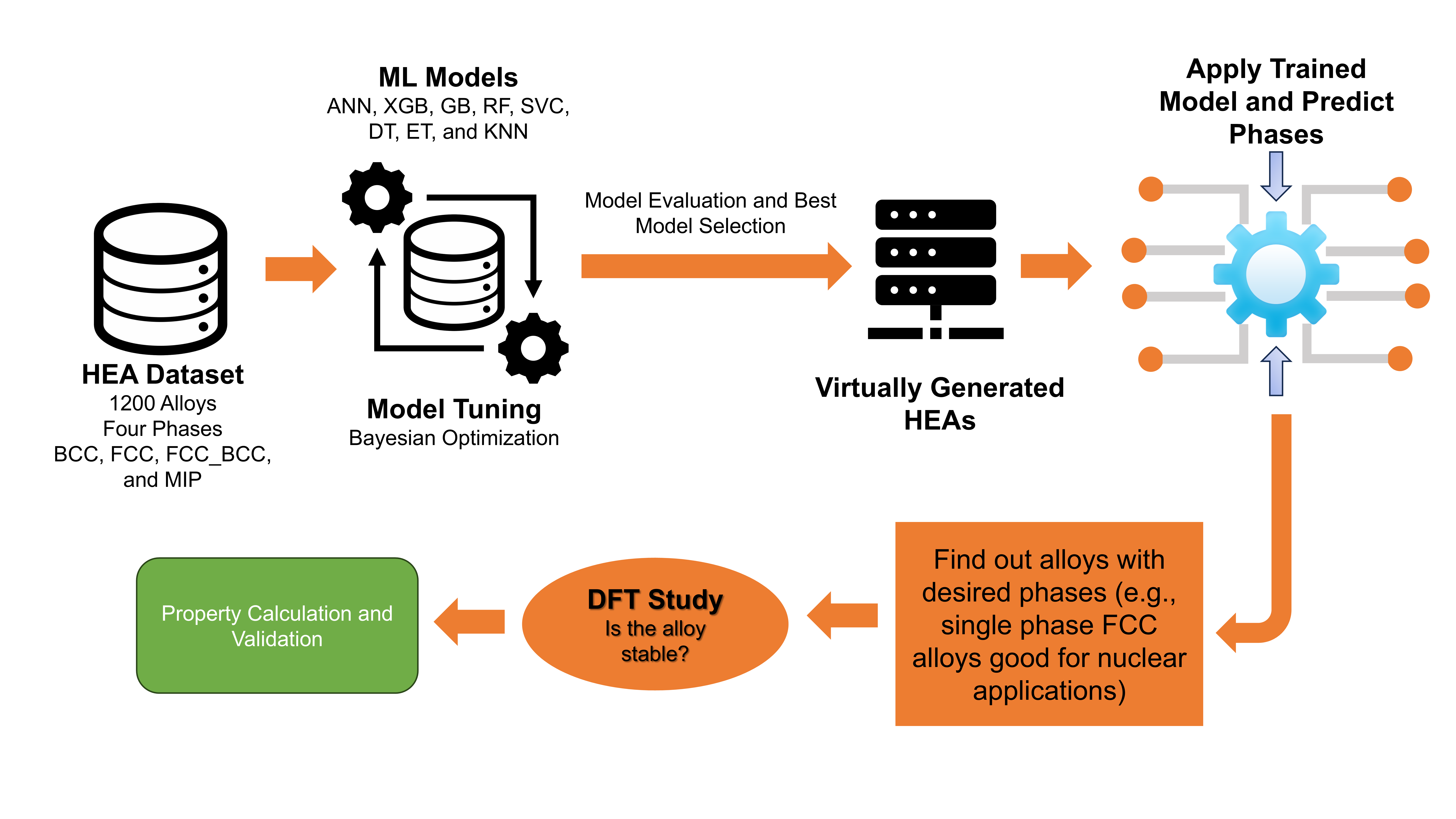
Multi-principal element compositions and complex phase behaviors define the transformative class of materials known as high-entropy alloys (HEAs). However, traditional trial-and-error discovery methods face significant challenges due to the large compositional space associated with HEAs. In this work, we propose a machine learning (ML)-driven framework to accelerate the design and screening of novel HEAs by predicting phase stability and guiding targeted synthesis. We first developed robust classification models using experimentally validated HEA datasets, incorporating 49 elemental descriptors. Among the tested algorithms, artificial neural networks (ANN) and extreme gradient boosting (XGBoost) exhibited the best performance: XGBoost achieved an accuracy of 0.886 and ROC-AUC 0.971 on the test set (see Table 1), while the ANN reached accuracy 0.878 and ROC-AUC 0.954. Using a probabilistic substitution model, 50,831 novel HEAs were generated and screened with the trained classifiers. From a small DFT validation set of twelve ML generated compounds, eleven showed negative formation energies and stability in the predicted phases. Calculation of phonon density of states confirmed the dynamical stability of the ML-predicted phases, further validating their thermodynamic stability. Investigations on AlCoCrFeNi revealed a Cr–Fe-rich disordered A2 phase and an Al–Ni-rich ordered B2 phase, both supported by thermodynamic and dynamical stability analyses. Overall, these quantitative outcomes demonstrate the framework’s ability to expand compositional search space while preserving physically plausible candidates.